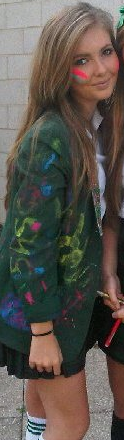
Hannah Webster, 18
Favourite music genre - Alternative
Favourite artist - Jamie T
Favourite magazine - LOOK
Hobbies - Maths
Harry Ablethorpe, 17
Favourite music genre - Indie
Favourite artist - Bloc Party
Favourite magazine - FHM
Hobbies - Skating
Bethan Dilley, 16
Favourite music genre -
Favourite artist -
Favourite magazine -
Hobbies -
Maisey Farrell,
Favourite music genre -
Favourite artist -
Favourite magazine -
Hobbies -
Monday, 14 November 2011
Thursday, 10 November 2011
Todays lesson
This lesson I have done further research on my reader profile by doing an online questionnaire using SurveyMonkey. This enables me to embed the survey on my blog for people to fill out and I can gather the results easily. I have also made further progress in my masthead for my magazine.
magazine language
After watching the powerpoint I realised how much thought goes into the front cover of a magazine.
-I learnt that in order to grab the audiences attention straight away, its better to put the title in the top left as we read from top to bottom, left to right, this means they automatically look at the title first if it is placed there.
-I also learnt some techniques used in the language which are often used. The three main ones are rhymes, alliteration and sibilance and intertextuality, which I learnt from the powerpoint means when words remind us of other media or phrases. These methods help engage the reader more and make the text more exciting, and are very effective.
-There are also a variety of sentence functions used on front covers aswell. The four are;
Declaratives : making a statement
Imperatives : giving orders
Interrogatives : asking questions
Exclamatives : suprise or alarm
All of these are used to engage the audience and are very successful and effective and I will corporate them into my magazine.
-I learnt that in order to grab the audiences attention straight away, its better to put the title in the top left as we read from top to bottom, left to right, this means they automatically look at the title first if it is placed there.
-I also learnt some techniques used in the language which are often used. The three main ones are rhymes, alliteration and sibilance and intertextuality, which I learnt from the powerpoint means when words remind us of other media or phrases. These methods help engage the reader more and make the text more exciting, and are very effective.
-There are also a variety of sentence functions used on front covers aswell. The four are;
Declaratives : making a statement
Imperatives : giving orders
Interrogatives : asking questions
Exclamatives : suprise or alarm
All of these are used to engage the audience and are very successful and effective and I will corporate them into my magazine.
Wednesday, 2 November 2011
Music Magazine Industry - What I have learnt
The powerpoints and slides on the blog helped expand my knowledge of music magazines and their culture as well as definitions and terms. I had come across the word 'demographic' before but was unfamiliar with what it meant. However, the slide gave me the definition and I now know that audience profiling is also known as the demographic, this helped my understanding of it. I also found the ratings of demographic and who comes under what category. For example, C1 is people like office supervisors, junior managements, nurses, special clerical staff and white collar workers in general.
After looking at the audience profiling slides I looked at the history of the music press. This gave me a greater understanding of magazines such as the content of the magazines which first came out. I knew 'Melody Maker' was the first magazine but I didnt know what the contents was, as it was the first one it would be very different to magazines out today. From the powerpoint I discovered that they were very positive of the musicians which featured in them. It consisted of mainly charts and ratings of singles, as well as the latest, up and coming gig listings. However, they began to change with the influence of drug culture and the introduction of The Beatles and The Rolling Stones which changed the nature of music and writing dramatically.
After looking at the audience History of the Music Press I looked at the Youth Sub-Culture powerpoint. It was here I discovered the history of the subcultures which are massively inspired by music. Although mainstream isnt a subculture it has a large impact on subcultures today. I learnt from this powerpoint that the views on mainstream audiences are not only the largest group and its like following the crowd, but also an opportunity to show off wealth and a sign of status and often seen as fake. This has made me have a different view on the mainstream audience and made me think about it.
After looking at the audience profiling slides I looked at the history of the music press. This gave me a greater understanding of magazines such as the content of the magazines which first came out. I knew 'Melody Maker' was the first magazine but I didnt know what the contents was, as it was the first one it would be very different to magazines out today. From the powerpoint I discovered that they were very positive of the musicians which featured in them. It consisted of mainly charts and ratings of singles, as well as the latest, up and coming gig listings. However, they began to change with the influence of drug culture and the introduction of The Beatles and The Rolling Stones which changed the nature of music and writing dramatically.
After looking at the audience History of the Music Press I looked at the Youth Sub-Culture powerpoint. It was here I discovered the history of the subcultures which are massively inspired by music. Although mainstream isnt a subculture it has a large impact on subcultures today. I learnt from this powerpoint that the views on mainstream audiences are not only the largest group and its like following the crowd, but also an opportunity to show off wealth and a sign of status and often seen as fake. This has made me have a different view on the mainstream audience and made me think about it.
Tuesday, 1 November 2011
Photo for front cover
I took this photo of a friend. I think it shows clearly it is a sixth former student as she is looking in a folder and not wearing uniform, and generlises a typical student in the way she is dressed and the way she is sitting. She is the main focus of the picture but there is plenty of space on the left hand side for text to be put. However, I editted this photo...
I didn't need to crop or rotate the photo but I thought it could do with boosting/enhancing the colour. I also made the photo a little bit crisper as it was a bit blurry and these changes have improved the photo I think.
Thursday, 20 October 2011
Subscribe to:
Posts (Atom)